CertSecure Documentation
  • Overview
    • About CertSecure Manager
    • Documentation Guide
  • Reference Guide
    • Header Bar
      • CertSecure Documentation
      • Swagger API
      • Profile Section
      • Search
    • Dashboard
      • Key Performance Indicators
      • Expiring Certificates
      • CA metrics
      • Key Strength
      • Signing Algorithm
      • Certificate Risk Report Profile
      • PKI Posture Management
      • NDES Health Information
    • AI Assistant
      • Chat
      • Configuration
      • Usage Report
    • Inventory
      • Overview
        • Overall
        • CertSecure
      • Template Management
        • Switch Templates
        • Exclusion List
        • Alert Templates
        • Certificate Templates
      • Template Categories
    • Discovery
      • Inventory
      • Scan Config
      • Cloud Config
      • Vault Config
      • Discovery Analytics
      • Scan Details
      • Discovery Ingestion
    • Reports
    • Utilities
      • ACME
      • Tasks
      • Integrations
        • Renewal Manager
        • Load Balancers
        • Discovery Agents
        • CLI Tool
        • Key Management
        • SEIM Tools
        • DevOps Tools
        • Ansible Automation Platform
      • NDES
      • Azure Key Vault
      • API Tokens
    • Enrollment
      • Certificate Request
      • Generate CSR
      • Enroll CSR
      • Generate Certificate
      • Import Certificate
      • Bulk Certificate Generation
      • Manage Policies
      • Organization Details
    • Administration
      • Users
      • Roles and permission
      • Certificate Authorities
      • Departments
    • Miscellaneous
      • Logging
      • Service Setup
        • Zoom
        • Zendesk
      • Settings
        • Configure Realms
        • Schedule Alerts
        • Metrics
        • Web Branding
        • About License
  • Setup & Architecture
    • Identity and Access Control
    • Architecture
    • Installation
      • Pre-requisites
      • Windows
      • Linux
      • Docker
    • Upgrade
      • Windows
      • Docker
  • Release Notes
    • Releases for 2026
      • v3.4.0
      • v3.3.1
      • v3.3.0
    • Releases for 2025
      • v3.2.0
      • v3.1.0
    • Releases for 2024
      • v3.0.0
  • Workflow
    • Approval Workflow
  • API Reference
    • Getting Started
    • Authorizing Requests
    • Securing API Access
    • Request and Response Conventions
    • Endpoint Reference
      • Health
      • API Token Management
      • CA Management
      • Templates
      • Certificate Enrollment
      • Inventory
      • Certificate Discovery
      • Tasks
      • Watcher Groups
      • Alerts
      • Reports
      • Logs
      • Monitoring
      • Scheduling
      • SMTP
      • ACME
      • Azure Key Vault
      • Google Cloud (GCP)
      • HashiCorp Vault
      • EJBCA
      • ServiceNow
  • Integration Guide
    • Renewal Manager
      • Workflow
      • Setup
      • Troubleshooting
      • IIS
      • Apache
      • Tomcat
      • Nginx
      • MSSQL
      • MongoDB
      • Oracle
      • Cloudflare
      • AudioCodes
      • Cisco ISE
      • Palo Alto PAN-OS
      • Cisco ACI
    • Load Balancer
      • F5
        • Workflow
        • Setup
        • Onboarding
        • UI Guide
        • Troubleshooting
      • NetScaler
        • Workflow
        • Setup
        • UI Guide
        • Troubleshooting
    • Certificate Authorities
      • ACME CAs
      • AWS
      • DigiCert Connector
      • EJBCA
      • GlobalSign
      • GoDaddy
      • HashiCorp Vault PKI
      • Microsoft AD CS
      • Sectigo
      • Sectigo-PS
    • Ansible Automation Platform
    • Azure Key Vault
  • Discovery Agent Setup Guide

Oracle

Renews the certificate stored in an Oracle wallet used by the listener.

Supported operating system(s): Windows only.
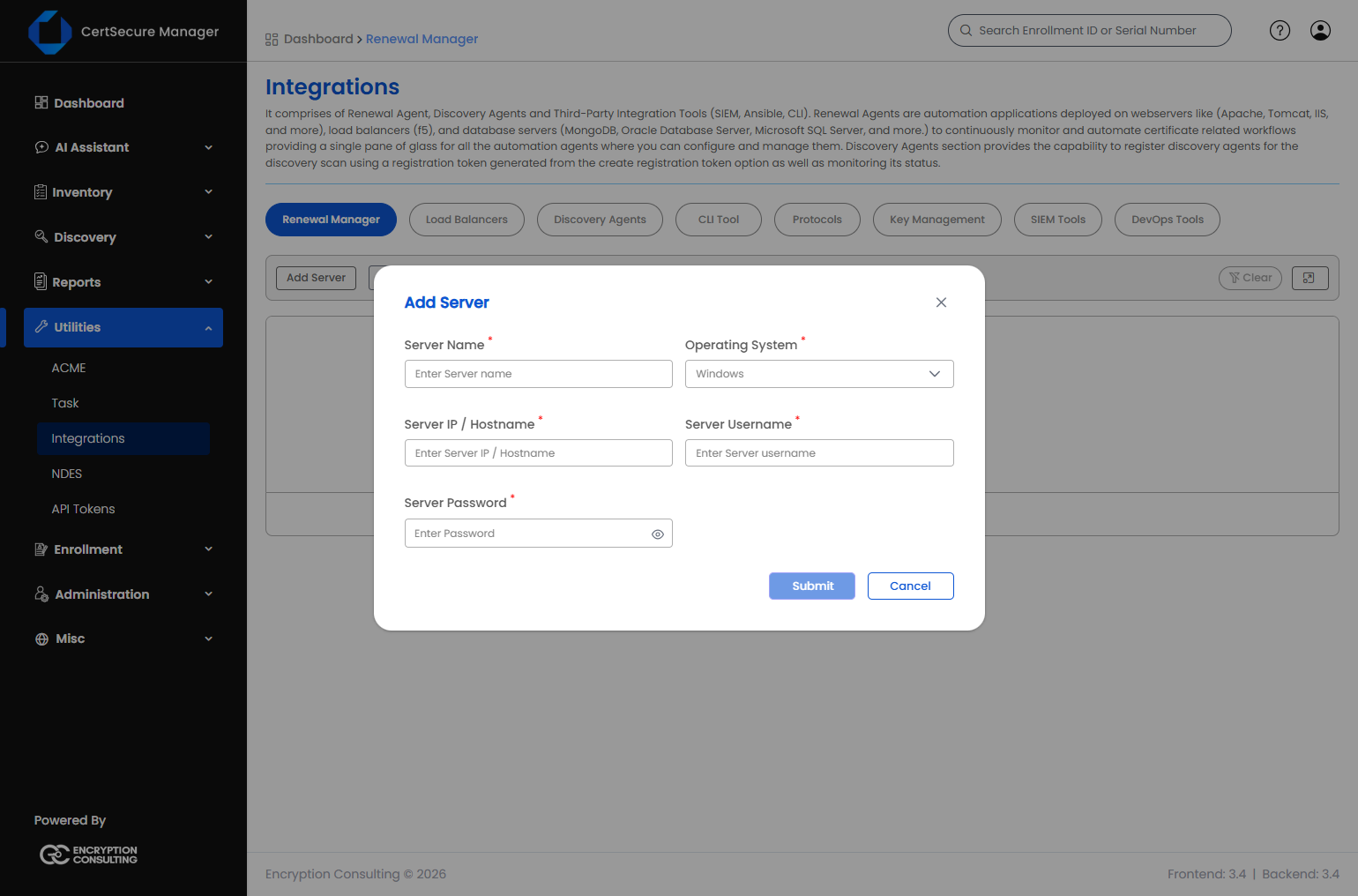
Adding an Oracle Server
  1. On the Renewal Manager tab, click Add Server (or click the Oracle tile in the connector grid).
  2. Fill in the fields below.
  3. Click Submit.
Oracle - Renewal Manager
Field Applies to What it means
Server Name Required, Add only A unique display name for this server. Cannot be changed later. Maximum 50 characters.
Operating System Fixed to Windows Oracle only runs on Windows targets.
Server IP Required The IPv4 address CertSecure uses to reach this server.
Server Username Required The WinRM account used to connect to this server.
Server Password Required The password for Server Username. Stored encrypted. On Edit, leave blank to keep the existing password.
Oracle Server List Actions

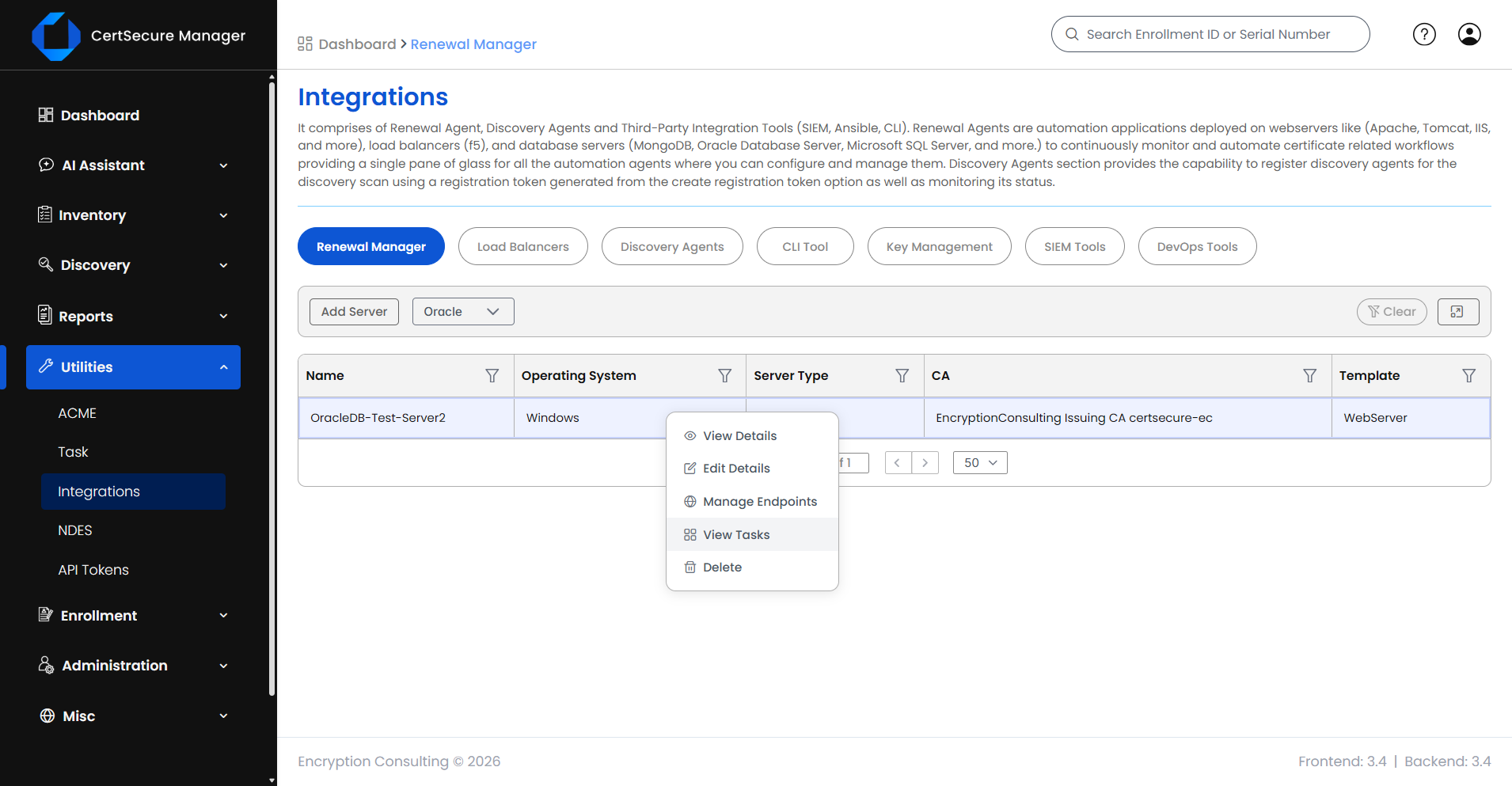
Right-click a server row (or open its actions menu) to see:
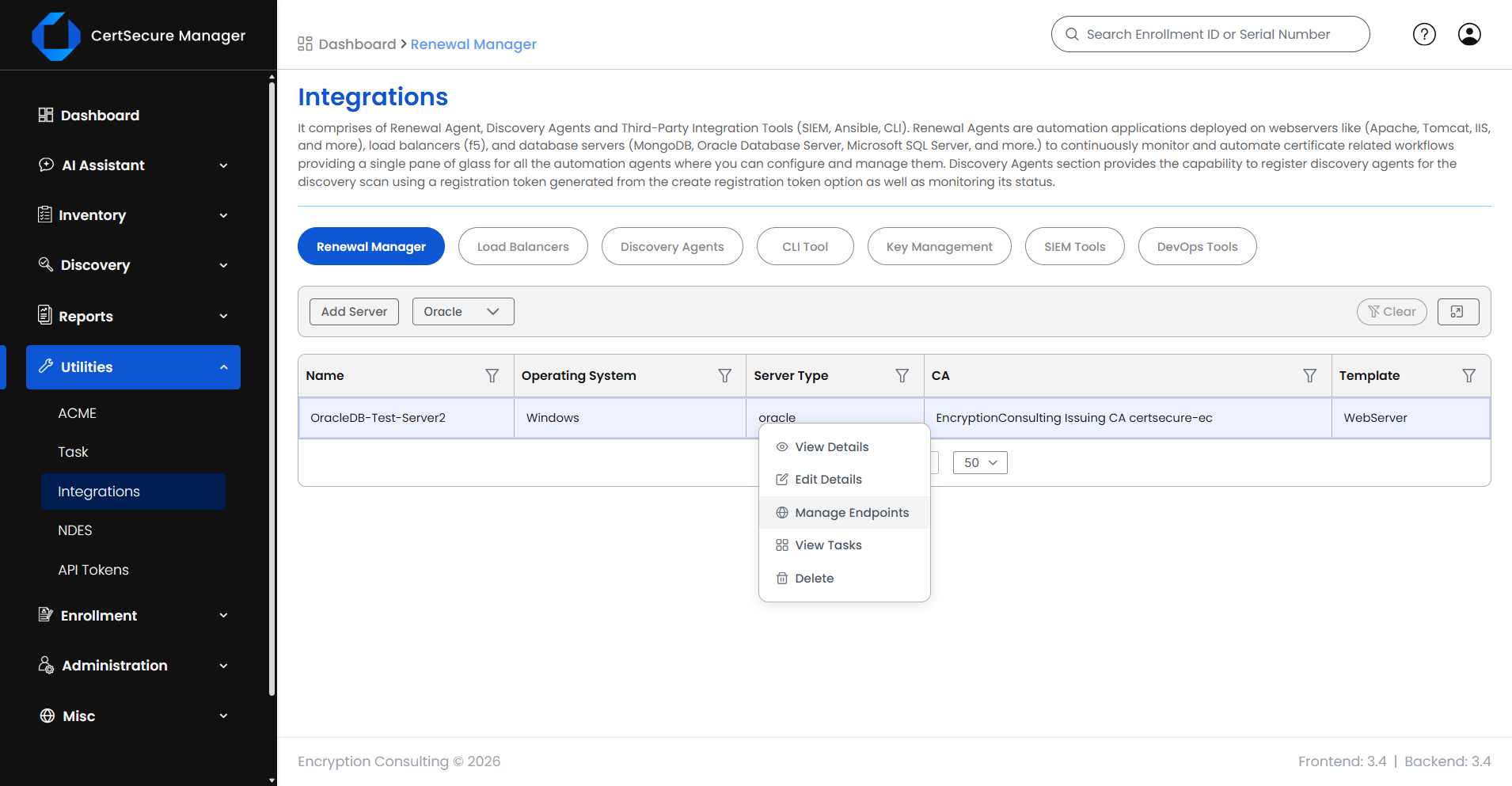
  • View Details – opens a read-only summary of the server's configuration.
  • Edit Details – reopens the Add Server form pre-filled, so you can update credentials.
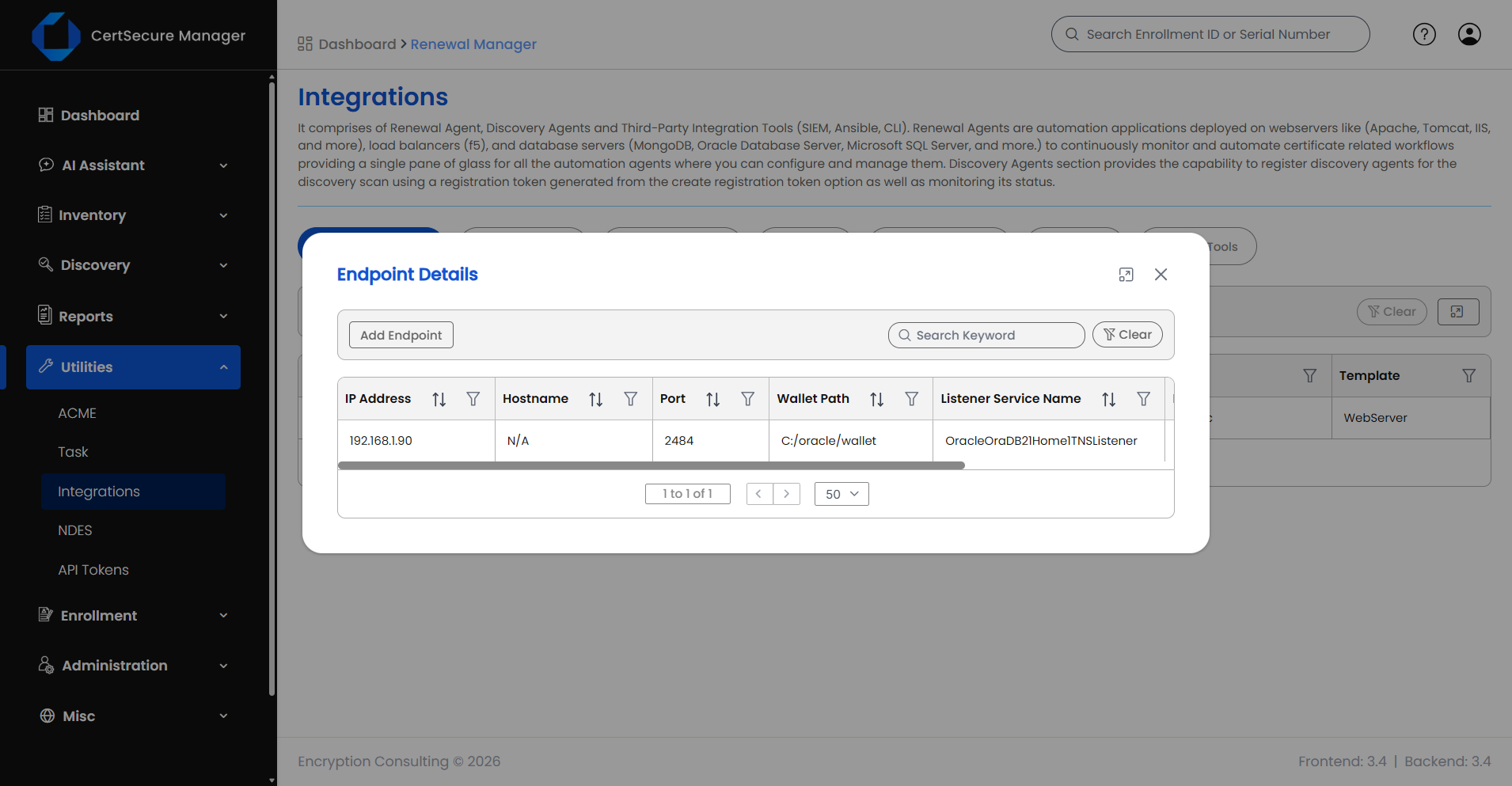
  • Manage Endpoints – opens the endpoint list for this server.
  • Push Certificate – issues a new certificate and imports it into the Oracle wallet you enter, without removing existing certificates or restarting the listener. See Pushing a Certificate.
  • View Tasks – opens the task history for this server.
  • Delete – deletes the server after a confirmation prompt. Deleting a server also removes every endpoint added under it.
Oracle - Renewal Manager
Adding an Oracle Endpoint
  1. From the server list, open Manage Endpoints on the server (right-click → Manage Endpoints).
  2. Click Add Endpoint.
  3. Fill in the fields below.
  4. Click Submit.
Oracle - Renewal Manager
Field Applies to What it means
Certificate Authority Required The CA that will issue renewed certificates for this endpoint.
Template Required The certificate template/profile to request from the selected CA. Options depend on the CA chosen.
Address Type Required Whether you will identify this endpoint by IP Address or by Hostname.
IP Address / Hostname Required The exact address of the TLS service to watch.
Port Required The TCP port the TLS service listens on, for example 443.
Wallet Path Required Full path to the Oracle wallet, for example C:/oracle/wallets/listener_a. Maximum 300 characters.
Wallet Password Required The password protecting the wallet. Stored encrypted. Minimum 3, maximum 100 characters.
Listener Service Name Required The Oracle listener service name, for example OracleOraDB21Home1TNSListener. Maximum 300 characters.
Listener Service Account Required The account the listener service runs as. Maximum 300 characters.
Owner Required The person responsible for this endpoint. Select an organization user from the list.
Organization ID Only when CA = DigiCert The DigiCert organization ID to request the certificate under.
Order Validity Only when CA = DigiCert How many days the requested certificate should be valid for.
Endpoint Actions

From the endpoint list, use the row actions (right-click or the actions menu) to:
  • View Details – opens a read-only summary of the endpoint.
  • Edit Details – reopens the Add Endpoint form pre-filled, so you can change the certificate settings (Certificate Authority, Template, Owner) and the other endpoint details. The address type, IP address / hostname and port cannot be changed; delete the endpoint and add it again to change them.
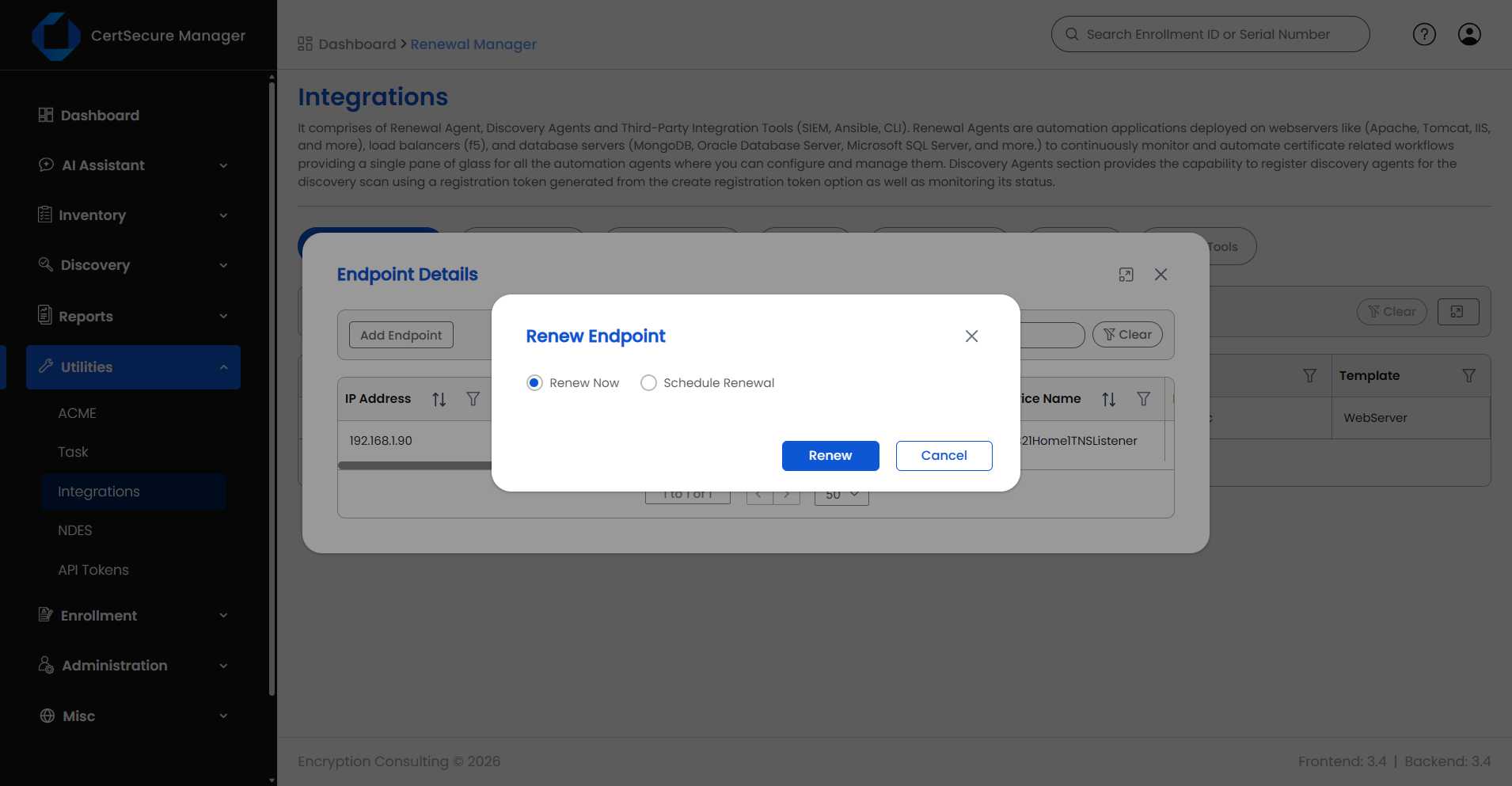
  • Renew – opens the Renew Endpoint dialog. Available only while automation is disabled for the endpoint.
  • Delete – removes this endpoint from the server. It does not affect other endpoints on the same server.
  • Change Request – creates a ServiceNow change request for this endpoint. See ServiceNow Change Requests.
Renewing an Oracle Certificate
  1. Open Manage Endpoints on the server, find the endpoint, and choose Renew.
  2. Pick one of:
    • Renew Now – queues the renewal immediately.
    • Schedule Renewal – pick a date and time at least 30 minutes from now using Enter Schedule Time.
  3. Click Renew (or Schedule if you chose to schedule it).
Oracle - Renewal Manager

Before you can renew manually:

  • The Renewal Manager Agent must be Online.
  • Automation must be disabled for that endpoint (see Automatic Renewal). While automation is enabled for an endpoint, its Renew option is unavailable.
  • The endpoint must already exist under the server. Add it first if it does not.
What Happens When You Renew
  1. The agent generates a certificate request using the wallet information you configured.
  2. It submits the request to the CA and receives the new certificate.
  3. It updates the Oracle wallet with the new certificate.
  4. It restarts the listener service you named.
Viewing Tasks

Here’s how to check renewal progress:
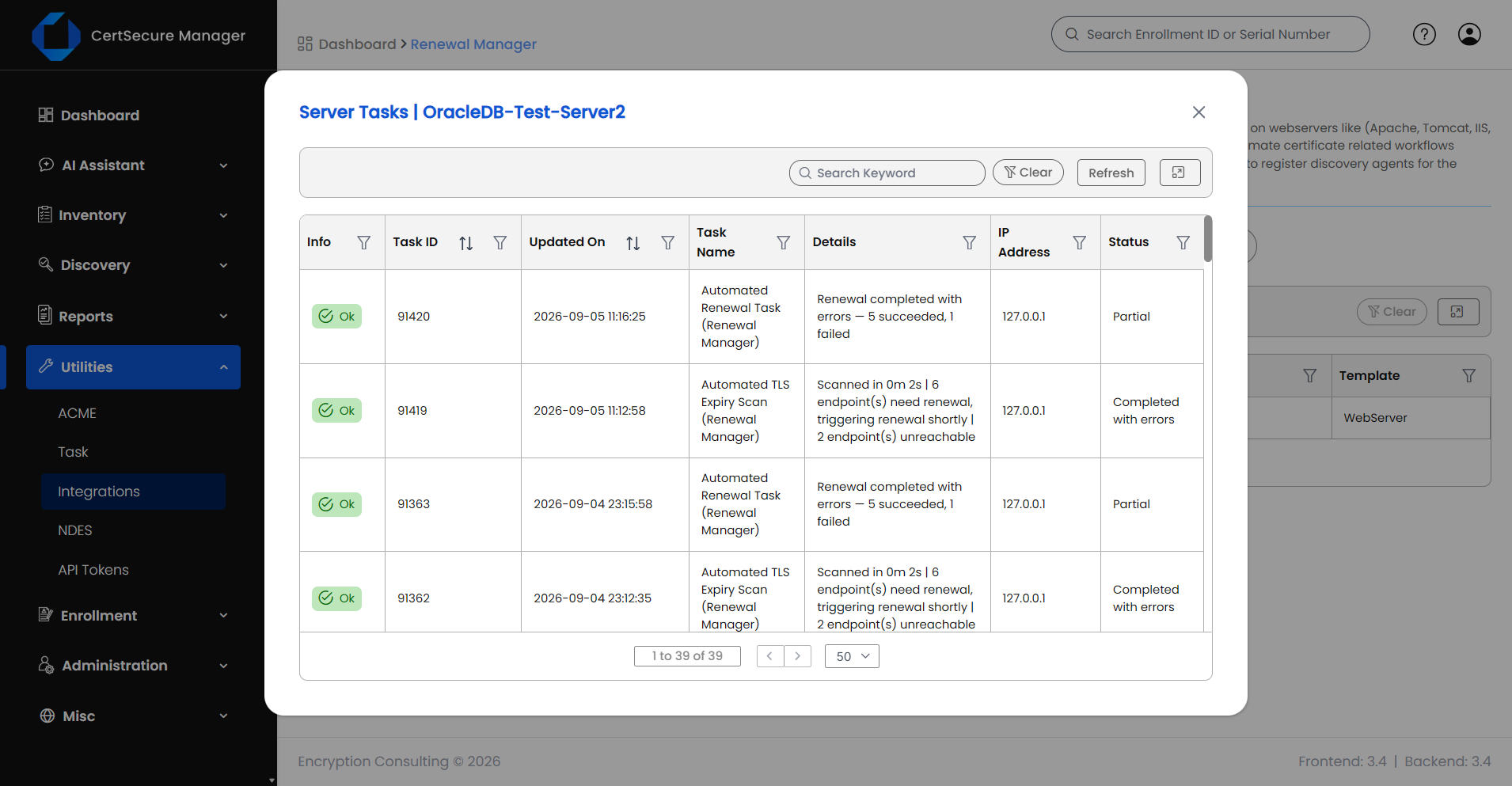
  1. Right-click a server → View Tasks.
  2. Use Search Keyword, the column filters, or Refresh to find a specific task.
Oracle - Renewal Manager Oracle - Renewal Manager

Task Columns

Column What it shows
Info A colored status badge: OK, ERROR, PROCESSING, PENDING, INITIALIZED, or WARNING.
Task ID The unique ID of this task.
Updated On When the task status last changed. Filterable by date.
Task Name What kind of task this is, for example a renewal or a scheduled TLS scan.
Details A short description of the current status or the last error.
IP Address The endpoint address(es) involved.
Status The current status text.

Task Status Meanings

  • INITIALIZED – the task was just created and is queued.
  • PENDING – waiting for the agent to pick it up.
  • PROCESSING – the agent is actively working on it.
  • OK – completed successfully.
  • WARNING – completed, but with something worth checking.
  • ERROR – failed. Check Details for the reason.
Before You Start
  • orapki must be on the server's PATH.
  • The issuing CA's chain must already be trusted inside the wallet (via orapki), or the renewal fails when the agent tries to import the new certificate.
  • Wallet Path, Listener Service Name, and Listener Service Account must exactly match the real Oracle configuration.
On this Page:
Support Privacy Policy Terms of Service

Copyright 2026 Encryption Consulting LLC. All rights reserved.